
You understand reality, you say?
Did you know reality may contain not 3 or 4, but 11 dimensions? Beyond a point, it becomes purely theoretical, but the human mind barely even comprehends the 4th.
SCIENCE AND TECHNOLOGY
Shreyash Manral
5/11/20265 min read
The Universe May Have 11 Dimensions. We Can Barely Understand 4.
Human beings have always had an adorable level of confidence about reality. We looked at the sky for thousands of years and concluded the Earth must obviously sit at the centre of everything. We thought time was absolute, space was fixed, and matter was solid. Physics has spent the last century taking those assumptions, folding them neatly, and throwing them into a fire.
Now modern theoretical physics casually suggests that the universe may contain not three or four dimensions, but eleven.
And somehow that sentence has not caused enough panic.
The strange thing is that dimensions are not “places” hidden somewhere in space. They are directions in which reality itself can move.
The 1st dimension is simply length. A point travelling in one direction creates a line. Add another direction, and you get the 2nd dimension, where flat shapes become possible. Add a third, and suddenly there is depth, volume, distance. The world begins to seem familiar to what we know.
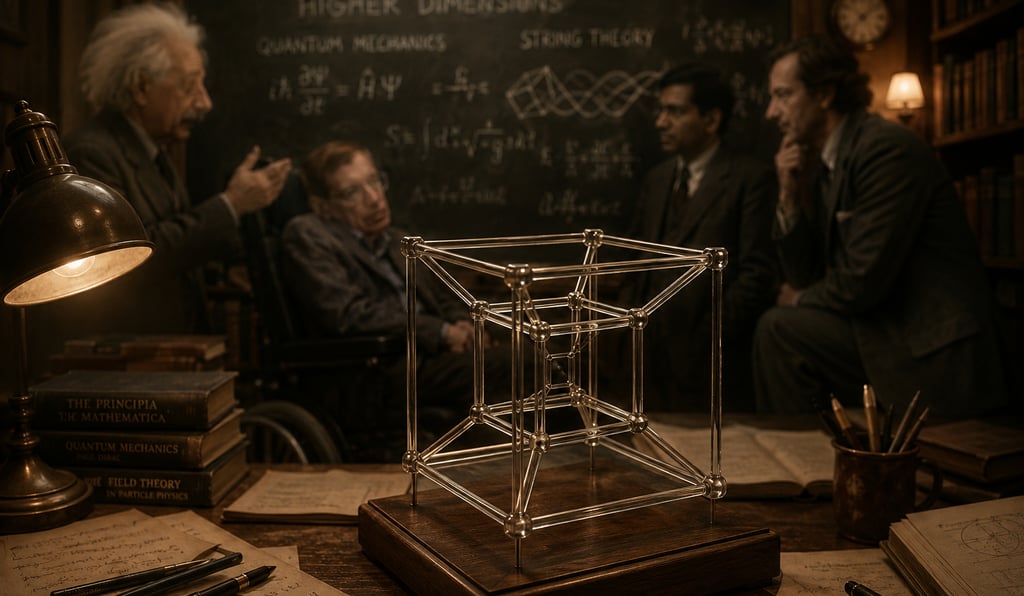
The 4th dimension is where things become slightly uncomfortable because physics treats time as a dimension too. Not just a measurement, but part of the fabric of reality itself. According to Einstein, space and time are woven together into one structure called “spacetime”, which we will cover in detail later. Which means the universe is less like a stage where events happen, and more like a giant geometric object where past, present, and future are tangled together in ways our brains were never designed to intuitively understand, hence we are what science calls a three-dimensional being.
So far, this is still manageable. Weird, but manageable.
Then quantum mechanics arrived, and physics collectively lost the plot. Now, what exactly do we mean by that? You would assume that if there is proof of something, or a discussion of something existing, we shall certainly be able to at least describe it in a way that all will agree to and comprehend with ease, but that is not true about Quantum Mechanics. This subject is still unclear to the greatest minds we have on the planet, let alone the average population. Not even Einstein truly understood or accepted the existence of such phenomena.
Quantum theory describes the microscopic world with terrifying accuracy. General relativity describes gravity and the large-scale structure of the cosmos equally well. The problem is that the two theories behave like divorced parents forced to sit together at a school function. They refuse to cooperate. Whenever physicists try combining them into one unified framework, the equations collapse into mathematical chaos.
And this is where extra dimensions begin appearing.
Not because scientists were bored and wanted reality to sound cinematic, but because the mathematics kept demanding more dimensions for the equations to remain internally consistent. String Theory, one of the most ambitious attempts at unifying physics, works properly only if the universe contains additional hidden dimensions beyond the four we experience.
That idea alone is difficult to process because humans instinctively assume that if something exists, we should be able to see it. But nature has never signed any agreement promising accessibility. Which means, there is no law that states reality is only that which can be seen; anything that does not meet the eye can very well exist as well.
According to these theories, the extra dimensions may be compactified, curled into unimaginably tiny scales that are impossible for us to directly perceive. Imagine looking at a tightrope from far away. From a distance, it appears one-dimensional, just a line stretched across space. But an ant walking on it would notice another dimension wrapped around the rope itself. Reality may behave similarly. The universe could contain hidden dimensions folded into every point of space, invisible simply because we are too large to notice them.
The 5th dimension is often described as a realm of alternate possible realities. This is where the conversation begins sounding less like physics and more like someone accidentally mixed philosophy into mathematics. If our universe represents one possible timeline, the 5th dimension could theoretically contain variations of that timeline where different outcomes occurred. A universe where Rome never collapsed. A universe where dinosaurs survived. A universe where you finally stopped procrastinating and became productive three years ago.
This idea loosely connects to the Many-Worlds Interpretation of quantum mechanics, proposed by Hugh Everett, which suggests that quantum events may branch reality into multiple coexisting outcomes. Reality, in that framework, does not choose one possibility and discard the others. It explores all of them.
Which is either fascinating or deeply exhausting, depending on how your week has been.
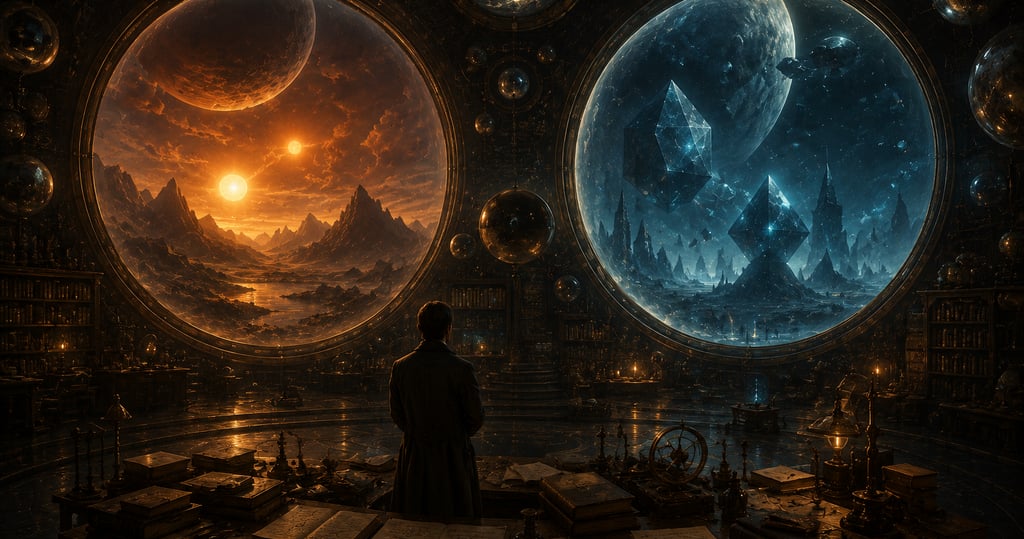
The 6th dimension extends this further by allowing movement between universes that began with the same initial conditions but evolved differently. By the 7th dimension, we begin discussing universes with entirely different starting conditions altogether. Different physical constants. Different laws of nature. Perhaps even realities where gravity behaves differently or matter itself cannot form the structures necessary for life.
The 8th and 9th dimensions push this concept into territory that language struggles to describe properly. They encompass collections of all possible universes and all possible laws governing them. At this point, human intuition stops being useful. The mind simply lacks the hardware to visualise structures this abstract. Mathematics becomes the only reliable language left because numbers can travel where imagination cannot.
And then comes the 10th dimension, which theoretical models describe as containing every conceivable timeline, universe, and physical possibility simultaneously. Not a collection of separate realities, but the complete structure containing all possibilities at once. A total map of existence itself.
This is usually the point where people either become obsessed with theoretical physics or decide humanity was never meant to know this much.
But physics was apparently not done embarrassing our understanding of reality.
The 11th dimension emerges from M-Theory, an extension of String Theory attempting to unify its different versions into one overarching framework. In this model, the fundamental building blocks of the universe are not particles, but tiny vibrating strings existing across higher-dimensional space. Different vibrations produce different particles, almost like notes emerging from the strings of a musical instrument.
Matter becomes vibration. Reality becomes resonance.
The 11th dimension allows these strings to exist within enormous multidimensional structures known as branes. Entire universes could theoretically exist on separate branes floating through higher-dimensional space, occasionally influencing one another through gravity. Our universe may not be the universe. It may simply be one layer in a far larger cosmic structure.
Which is a slightly unsettling thought, considering humanity still argues on the internet about whether the Earth is round.
Of course, none of this has been experimentally confirmed. That part matters. String Theory remains mathematically elegant but scientifically incomplete because we currently lack the technology to directly test many of its predictions. Some physicists remain sceptical that these extra dimensions physically exist at all.
But even if these theories eventually turn out to be wrong, the implications are still extraordinary. A species that once thought disease came from evil spirits is now attempting to mathematically model eleven-dimensional reality. Human beings evolved to hunt, survive, and avoid predators on a rock floating through space. Yet somehow the human brain became capable of questioning the architecture of existence itself.
And perhaps that is the most beautiful part of science.
Every major discovery has gradually removed humanity from the centre of reality. The Earth was not the centre of the solar system. The solar system was not the centre of the galaxy. The galaxy was not the centre of the universe. And now modern physics quietly hints that even our entire observable universe may only be a small visible fragment of something vastly larger.
A hidden structure beneath reality itself.
The uncomfortable truth is that the universe does not care whether humans find it intuitive. Reality is under no obligation to make sense to creatures that panic when WiFi stops working for six minutes.
And yet, despite how absurd and incomprehensible all of this sounds, there is something strangely comforting about it.
Because it means mystery still exists.
The universe is still capable of being larger than our imagination.